
Membership Composition as Discipline, Place, and Cohort
Demographic composition of this association's membership is the distribution, at a stated extract date, of persons holding membership across three coded attributes: disciplinary affiliation, geographic base, and generational position understood as career-stage cohort. The fundamental unit of analysis is the member in good standing. Before describing any pattern across research areas, events, or scholarly networks, the administrative office must print the exact extract date the file covers.
Once that definition and date are fixed, the same administrative file can answer three distinct questions. First, who sits on the roll at the extract date establishes composition. Second, who newly entered the association during the interval since the prior extract measures recruitment. Third, who renewed among those eligible to renew captures retention.
Keeping these three questions separate prevents analytical confusion. The discipline, base, and career-stage breakdown must preserve the distinction between who is on the good-standing roll, who joined between extracts, and who renewed from the eligible membership.
Administrative Roll Boundaries and Missing Records
A membership roll is an administrative list kept for dues, voting eligibility, and mailings for publications and awards. It is not a probability sample of sociologists or of scholars studying global Jewish populations. Consequently, the resulting profile describes members in good standing during the extract period only, rather than the research populations members study or the wider academic disciplines.
When inspecting the raw file, an analyst often sees what looks like a clean distribution across departments and regions—until a controlled check of the uncoded rows restores the blank fields to the table. Treating blank discipline, region, or cohort fields as absent groups distorts the baseline. Dropping blanks shrinks the denominator and invents a cleaner roll than the office actually holds.
I treat every blank attribute field as an explicit unknown category within its respective breakdown. A member record can carry a known disciplinary code alongside an unknown region. Furthermore, a retained workplace affiliation or mailing address carried over from a previous cycle represents an administrative record of past contact; it provides no verification that the scholar remains at that institution unless the date of last confirmation is checked.
Disciplinary Affiliation as the File Actually Codes It
Reading disciplinary composition requires starting from the exact categories the membership form offers. For this association's audience, that inspection begins with sociology and Jewish studies, alongside whatever adjacent codes the database actually stores—whether history, demography, anthropology, or allied fields. Without inspecting the live code list and the extract itself, an analyst has no basis to assert which fields dominate or to assign an assumed share to any specialty.
Dual affiliation introduces a strict technical limit: a scholar working across sociology and Jewish studies cannot be represented in both categories without altering the table's total. The way around this limit is to select and document a single counting rule before tabulating the extract. That choice carries an analytical cost.
- Primary-code rule: Each member is counted once under a single designated primary discipline (or unknown). The column sum equals the unduplicated member total, but secondary departmental homes disappear from the view.
- Multiple-affiliation rule: A member is counted in every disciplinary category selected on the form. This preserves cross-disciplinary breadth, yet the sum of disciplinary entries exceeds the headcount of members in good standing.
The documentation accompanying the table must state which rule the extract uses and never mix the two within a single comparison. A heavy concentration in one departmental home would support different assumptions about panel vocabulary at annual events and readership for association publications than a mixed roll would, which raises the question: which counting rule better serves the editorial board and program chair?
Geographic Base Versus the Global Scope of the Research
Geographic composition in an association file records the member's coded institutional or residential base. It does not track the country, city, or community where that member conducts research. A globally studied Jewish population is not a globally distributed membership: the geographic boundary follows members' coded institutional or residential bases, not the communities their research describes.
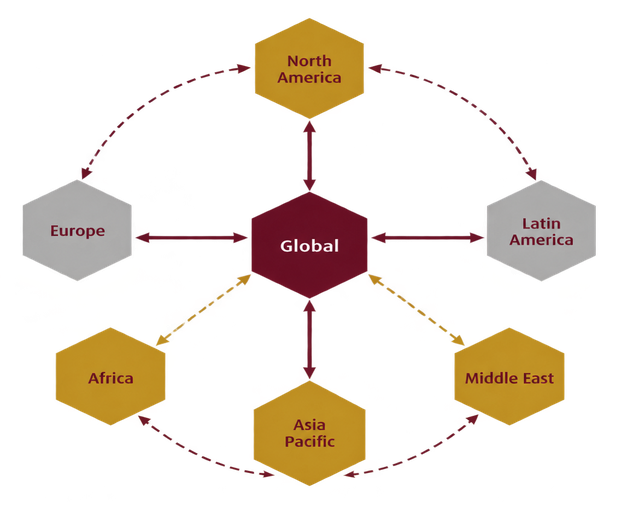
Before comparing regional counts, the analyst must document whether the extract pulls from institutional addresses or residential addresses, and keep that choice constant. Thin regions in the file are simply thin records until a specific comparison population is named. Moreover, an empty or sparse regional row requires checking the form's history and the member ledger to distinguish three different administrative realities:
- A region offered on the membership form that currently holds no coded members in good standing.
- A region where prior members reside who did not renew during the current cycle.
- A region never offered as a selectable code on the intake form.
Only the administrative file and its historical code book can establish which gap applies. If the office renames or consolidates regional labels between extracts, that revision must be logged as a coding change rather than narrated as physical migration by scholars.
Career-Stage Cohorts on the Current Roll
In demographic theory, a cohort groups individuals who experience a defining event within the same time interval. On an association roll, generational position holds up only so far as the administrative fields actually support a career-stage cohort—such as student, early career, mid-career, or senior—if those are the explicit categories in use on the form.
Push the term further, toward named birth generations, and the concept stops holding. If the membership database stores year of highest degree or year of joining the association instead of explicit stage labels, the analysis must report degree-year or joining-year cohorts directly. Translating a degree year or an entry year into a birth generation introduces unverified assumptions about age at matriculation and career continuity.
Career-stage dynamics also separate recruitment from retention. Students and newly minted scholars entering the association swell the recruitment column. Retention, however, is read strictly through renewal from one extract to the next. When an existing student member renews while advancing into the early-career category, the ledger records a retention renewal paired with a stage transition—never a new join. How should the longitudinal table classify a renewing member who crosses a career-stage boundary between extracts?
Joins, Renewals, and Representation Read as One Comparison
Rather than treating recruitment drives and retention audits as separate narratives, the membership office can maintain a three-column comparison across every locked category: composition at the extract date, new joins since the prior extract, and renewals among those eligible to renew.

Building this comparison requires tracking unique member identifiers across extracts. A current snapshot alone cannot reveal when a scholar entered the association. Similarly, calculating renewal requires establishing a formal eligibility pool based on the association's bylaws and billing rules; newly recruited members who joined during the current cycle are not part of the renewal-eligible denominator from the prior cycle. When evaluating stage-specific retention, the office must also document whether eligible members are grouped by their career stage at the start of the renewal window or their stage at the later extract, and keep that convention fixed.
Award Eligibility Baseline: In a small scholarly society, recruitment gains in one category can mask nonrenewal in another; tracking joins alongside eligible renewals prevents the committees overseeing awards and travel resources from mistaking high turnover for net growth.
Claims about representation require an additional step. Composition becomes a measure of representation only when set against an external denominator that the association names in advance. The administrative roll does not supply that external population, and an analyst must not borrow an unverified benchmark from an unnamed study. Finally, a longitudinal trend exists only when two extracts share the exact same definition of a member in good standing and the same category lists. A revised intake form creates an administrative break, not a demographic shift in who belongs.
Repeating the Extract Without Changing the Categories
Maintaining a longitudinal record across membership cycles requires a strict operational sequence. Methodological literature on population registers suggests that consistent classification across time intervals is the prerequisite for measuring true cohort change. To execute a repeatable extract, the office should follow five steps in order:
- Freeze the unit definition: Lock the operational rules that define a member in good standing before pulling records.
- Lock the attribute lists: Hold the code lists for disciplinary affiliation (sociology, Jewish studies, and verified adjacent codes), geographic base, and career stage constant across extracts.
- Retain the unknown rows: Keep missing values visible as an explicit unknown row in every single-attribute table rather than imputing a plausible discipline, region, or stage.
- Stamp the extract date: Record the exact date of the data pull directly on the file and in all summary tables.
- Verify locks before matching: Compare a later extract against an earlier one only after confirming that the unit definition and category boundaries have not shifted.
When preparing tables for public distribution or internal newsletters, privacy protection takes precedence over granular display. In a specialized scholarly association, cross-tabulating discipline by region and career stage can easily produce cells small enough to identify an individual scholar.
Small-Cell Disclosure Safeguard: When a cross-tabulated cell is small enough that a reader could identify a specific person, describe the pattern in prose or combine the cell with a compatible neighboring category for publication, while preserving the uncombined codes in the locked internal file.
Documenting publication-level aggregations separately ensures that disclosure control does not silently alter the coding structure for the next administrative extract. Even when executed with complete precision, this repeatable extract profiles the association's own roll during the stated extract period; it does not measure the global Jewish populations members study, the wider academic disciplines, or the academic labor market of either field.
Which Thin Spot Should the Next Cycle Try to Fill?
With the definitions fixed, the unknown rows preserved, and the three-column comparison of composition, joins, and eligible renewals in place, the administrative protocol is ready for governance use. Given only the categories the current extract can support, which single thin spot—a discipline, a region, or a career stage—should the next recruitment cycle be judged against, and what renewal result would show that the cycle worked?