
Leaving the Dock with an Unfinished Literature Review
I open the log on an overcast morning with the barometer falling, a half-packed literature review on diaspora stratification, and no membership map. Emerging scholars who misread which societies actually set Jewish sociological agendas lose years of review circuits, archival introductions, and hiring visibility. The first decision involves which scholarly circuit should encounter the question while its survey design, comparison cases, and vocabulary can still change—waiting until acceptance leaves little time to locate mentoring or adjacent panels.
Missing the right institutional departure point carries a heavy cost in field terms. A researcher experiences missed panels on diaspora stratification and delayed feedback on survey design. They face isolation from the small circuit that still reads Jewish population research as sociology. To prevent this drift, map three kinds of access roughly 8 to 12 weeks before the first conference-proposal deadline under consideration. Identify relevant paper sessions, locate the journal connected to the association, and pinpoint recurring opportunities to meet editors or discussants.
Mapping the Institutional Channels of Jewish Population Research
Scholarly associations organize Jewish sociological research across recent decades through journals, prizes, and recurring meetings. Institutional function dictates the structure of this chart. The Association for the Social Scientific Study of Jewry occupies the dedicated berth because it organizes social-scientific conversation about Jewry. Beside it runs the wider current of general disciplinary societies, especially the American Sociological Association, where Jewish cases must answer broader theoretical questions.
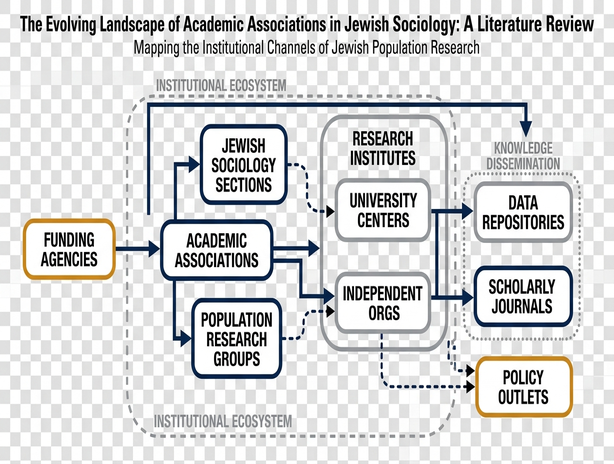
Read the wake of these societies chronologically to understand their current debates. Postwar community studies lead into later work on demography and identity. This flows into sustained Israel-diaspora comparison and eventually widens into global-population questions. As Sergio DellaPergola outlines, demographic policy frames span both Israel and the diaspora. Understanding this progression helps position new research within an ongoing conversation.
For each association under consideration, record four specific items in a one-page chart. Document the publication outlet, the meeting pathway, the prize or recognition structure, and the disciplinary audience expected to understand the paper. This document becomes the primary navigation tool for the academic year.
Navigating the Tension Between Specialized Cases and Broad Theory
A standing tension pulls Jewish sociology between a specialized association culture and the demand to speak in general sociological theory. In the conference corridors, Israel, diaspora, religion, and race appear as competing meridians. Each meridian can determine where a proposal is routed and which literature a discussant expects. Institutional roles come under stress during these debates. Program committees decide whose methods are treated as central, whether survey, ethnography, or historical sociology. They also determine how global Jewish populations beyond a few national cases get sidelined or highlighted.
Proposal Auditing Protocol
I sort prospective papers twice to survive this squall. First, I categorize the work by its Jewish empirical object. Second, I classify it by its general sociological problem. This dual sorting ensures an ethnography of communal life arrives with theoretical weight and a population paper connects to broader demographic trends.
Audit a proposal at three distinct levels before submission. Examine the population named in the title. Scrutinize the method identified in the abstract. Evaluate the general sociological claim stated in the final two sentences. Check whether the comparison extends beyond a small group of frequently studied national settings before treating the argument as one about global Jewish populations.
Dropping the Sounding Line into Conference Programs
The conference program functions as a sounding line for the field. Paper sessions reveal who frames Jewish population, identity, and communal-organization questions. Mentoring breakfasts expose the field's informal advice channels. Journal conversations show whether a conference paper has a plausible editorial destination. The Marshall Sklare Award, conferred by the Association for the Social Scientific Study of Jewry, operates as a public marker of senior standing in this exact space—a signal of who frames the field's informal advice channels.

As Calvin Goldscheider details, historical field framing requires understanding how senior scholars shape the study of Jewish futures. Emerging scholars benefit immensely from repeated exposure to the same reviewers and discussants who later handle manuscripts on Jewish population and communal organization.
Four to six weeks before a meeting, identify two relevant sessions, one mentoring opportunity, and one scholar whose published method bears directly on the project. Within seven days after the meeting, send a short follow-up that names the paper or methodological issue discussed. Record meeting coordinates strictly as city, time zone, session title, and institutional role.
Sequencing Your Submissions Across Dual Memberships
A practical order of operations keeps a research agenda moving forward. Read the dedicated journal closely enough to recognize its recurring questions. Prepare a meeting submission for the specialized association. Join the general disciplinary society so Jewish topics find a broader theoretical audience.
Consider the trajectory of two different graduate students. One student confines their presentations entirely to Jewish-studies congresses and receives strong contextual criticism. Another student presents stratification or migration work to general sociologists. The second student gains theoretical feedback that strengthens the underlying mechanics of the research. Plan one specialized meeting and one general sociology meeting within a 12-month cycle. Budget for registration, travel, lodging, and one schedule buffer.
The Two-Column Translation Strategy
Maintain a two-column manuscript file during the drafting phase. Place the Jewish-studies contribution on the left and the general sociological mechanism on the right. Revise any section that can fill only one column. This ensures the work remains legible to both audiences.
Volunteer first for a bounded role such as session presider or proposal reviewer before pursuing elected office or a continuing committee assignment. Professional ethics and authorship norms guide these interactions. Use the American Sociological Association Code of Ethics from 2018 when checking authorship, disclosure, professional conduct, and responsibilities to research participants. This association chart cannot supply Hebrew or Yiddish language skills, replace fieldwork, repair weak methods training, or represent the world's Jews as a census. It simply shows where debates are amplified, reviewed, and carried into disciplinary sociology.
Anchoring the Work in a Dedicated Scholarly Public
After navigating the squalls of parochialism and the rigging of dual membership, associations emerge as a navigable channel. Inspect the tables of contents for the two most recently completed volumes of the target publication. Classify relevant articles by population, method, and general sociological problem. Carry the resulting paper outward in two forms. Create a version legible to specialists in Jewish population and identity research. Draft an abstract framed for a general sociology area such as migration, demography, religion, race, or stratification.
At landfall, the route tests against a visible institutional fact. Contemporary Jewry serves as the official journal of the Association for the Social Scientific Study of Jewry, turning membership into an entry point to a scholarly public with recognizable questions, reviewers, prizes, and meeting conversations.